


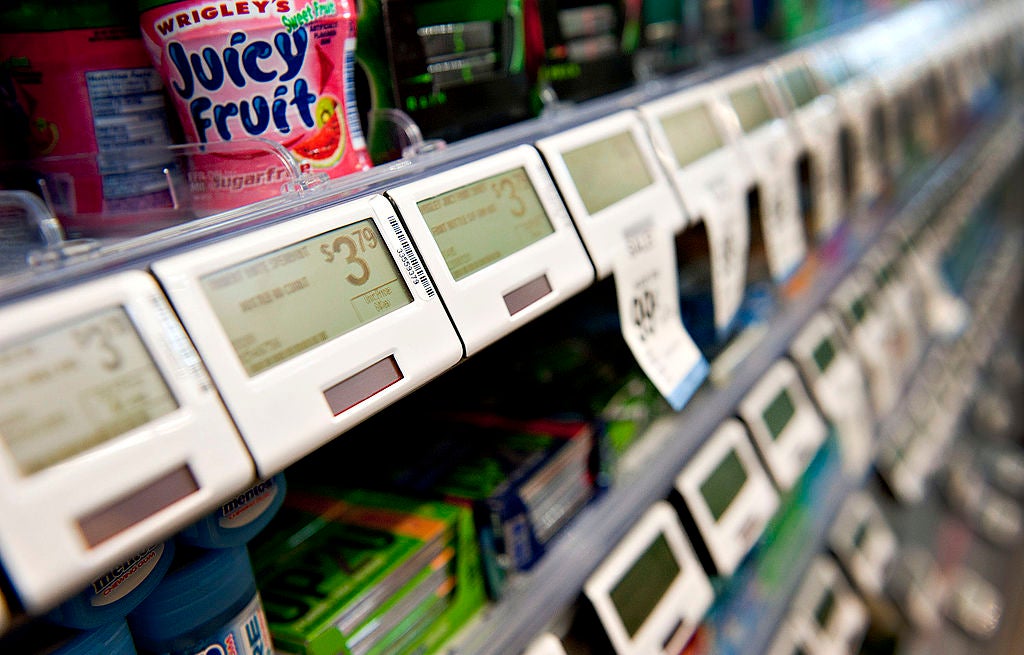
Does your grocery store hike the price of milk during your hurried commute home? Is it raising the cost of ice cream during a July heat wave? Are you seeing “personalized” prices based on your income or shopping history? As technology advances, these scenarios are becoming increasingly realistic.
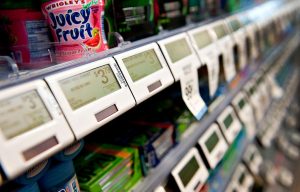
Put simply, it comes down to a small, digital screen that’s replacing the paper price tag on some retailers’ shelves. This battery-powered device is called an electronic shelf label, or ESL. Stores that use this technology can now change prices with a few clicks — or even allow an algorithm to do it automatically.
ESLs are currently being used by major U.S. chains such as Walmart, Kroger, Whole Foods and Amazon Fresh, as well as by some stores in Canada, Europe and Asia. The global market for ESL products was estimated at $2.09 billion in 2025 and is projected to reach $7.32 billion by 2033, according to Grand View Research.
The ‘slippery slope’ of digital price tags
Retailers say ESLs lift the manual burden for store employees of maintaining paper price tags. They also claim ESLs make it easier to lower prices on perishables to help keep them from going to waste.
However, consumer advocates worry the technology could make it easier for stores to surge prices during times of high demand — as well as to change prices for each consumer based on personal information, including through facial recognition capabilities.
Surge pricing (also known as dynamic pricing) may seem absurd when it comes to groceries. However, consider how commonplace the practice has become among airlines, rideshare providers and ticket-sellers. Unlike these discretionary expenses, however, food is a necessity — and with budgets already stretched thin by inflation, the prospect of even higher prices can add a new layer of financial anxiety to your grocery trips.
Various retailers that use ESL technology have responded to such concerns, stating they’re not using it for price gouging — and that they don’t plan to do so in the future.
That said, ESL technology presents a “slippery slope,” with uses that could expand over time, says Ema Roloff, co-founder of digital strategy advisory firm Roloff Consulting.
Stores are not doing [dynamic pricing] right now while there’s a lot of outrage over installing [digital] price tags. They’re not going to rock the boat when it’s at the top of people’s minds. But down the line, when everybody’s used to these price tags, stores won’t necessarily be thinking about it the same way they are right now.
— Ema Roloff, co-founder, Roloff Consulting
A consumer’s take: ‘Subtle and built-in’ practices
While some consumers don’t pay much attention to digital price tags, others are wary of how they may impact a store’s pricing practices. Among those with reservations is Patrick Alexander, an insurance claims adjustor and online content creator from Indianapolis, Indiana.
“The one thing that’s weird about this is the customer would never know it’s happening because it’s so subtle and built in. You spend $1.50 on Greek yogurt at 2:00 in the afternoon, and then after work you’re spending $1.95 on the same thing. You may not even notice it because you’re in a rush.”
— Patrick Alexander, insurance claims adjustor, Indianapolis, Indiana
Like Roloff, Alexander uses the term “slippery slope” to describe the use of ESLs. “If you can get away with doing five or 10 cents at a time, eventually you’re going to do 50 cents or a dollar, two dollars,” he says.
Alexander says he avoids shopping at stores that use ESLs, as well as at stores that don’t include prices on items’ tags or shelf labels. “The subtleties of ripping people off — I guess you’d call it that — are really getting ingrained,” he says.
Retailers respond to price-gouging claims
Amidst all the talk of using ESLs for price gouging — and even legislation that aims to prevent it — two of the largest U.S. grocery retailers maintain they do not use the technology for such purposes.
Walmart
“If you talk to the people who shop in our stores every week, we think they will have a different view,” says Robyn Babbitt, director of corporate communications for Walmart. “These labels are just a modern tool to help our associates do their jobs better, but the price you see is the same for everyone in any given store. They see the work we do every day to keep things affordable.”
Currently, around 2,300 Walmart stores are using digital shelf labels, and the retailer expects all its locations to be equipped with them over the next year. Walmart’s website states that its prices are the same for all customers in a given store, and they remain consistent regardless of demand, time of day or who is shopping.
Babbitt refers to a white paper published in 2025 by economists from the University of Texas at Austin, University of California San Diego, and Northwestern University. For their study, the researchers examined data from an unnamed major U.S. grocery retailer that implemented ESLs at more than 100 stores starting in October 2022. “We find virtually no surge pricing either before or after ESL adoption,” they wrote, adding, “Our results suggest that recent regulatory concerns regarding surge pricing in grocery retail are misplaced.”
Kroger
Supermarket chain Kroger launched ESLs in dozens of its stores in 2018, and has since been installing them in additional locations.
In 2024, two U.S. senators sent a letter to Kroger’s CEO, stating their concerns that the technology could be used for dynamic pricing. Changing prices based on the “time of day, the weather, or other transitory events” could enable “stores to calibrate price increases to extract maximum profits at a time when the amount of Americans’ income spent on food is at a 30-year high,” read the letter written by Sen. Elizabeth Warren (D-Mass.) and former-Sen. Robert P. Casey, Jr. (D-Pa).
In response to the senators’ letter, Kroger released a statement that read, “To be clear, Kroger does not and has never engaged in ‘surge pricing.’ Any test of electronic shelf tags is designed to lower prices for more customers where it matters most.”
Kroger didn’t respond to requests from Bankrate for comment for this article.
The legal battleground
Federal legislation against grocery price gouging
While Walmart and Kroger have stated they’re not using their ESL technology for price gouging, stores may be prohibited from ever doing so, thanks to pending federal legislation and various state laws already in place.
At the heart of this legislative push is the Stop Price Gouging in Grocery Stores Act. Introduced in February 2026 by Sens. Ben Ray Luján (D-N.M.) and Jeff Merkley (D-Ore.), the bill would:
- Ban electronic shelf labels in grocery stores larger than 10,000 square feet
- Prohibit grocery stores from practicing surveillance pricing, which is the use of personal data to set individualized prices for goods
- Requiring grocery stores to disclose the use of facial recognition technology
With food costs rising each month, it’s more important than ever that any new technologies implemented in grocery stores are helping to lower costs, not raise them. That is why I’ve introduced legislation that is intended… to put common-sense guardrails in place at large retail stores and protect consumers.
— Sen. Ben Ray Luján (D-NM)
Congresswoman Rashida Tlaib (D-Mich.) also introduced legislation in the House of Representatives in August 2025 that would ban ESLs.
Both the House and Senate bills have been referred to committees for hearings, and whether either will be passed into law — at a time when Congress is narrowly divided — remains to be seen.
Price transparency bills introduced across 33 states in 2025
While federal lawmakers have been working on legislation, states have been introducing, and sometimes passing, bills of their own.
Last year, more than 100 price transparency bills were introduced across 33 states and Washington, D.C., according to MultiState, a state and local government relations company. These included dynamic pricing disclosure laws, algorithmic pricing regulations and surveillance pricing protection measures.
One supporter of such legislation is the United Food and Commercial Workers International Union (UFCW), which launched a national campaign to “ban the predatory practice of ‘surveillance pricing.’”
Now is when you can put legal constraints around this, before it’s largely adopted and being so abused that there’s no way to put the genie back in the bottle. Right now we could put the genie back in the bottle. And I think that’s the opportunity that folks need to realize.
— Ademola Oyefeso, UFCW International vice president and director of legislative and political affairs
Oyefeso believes the federal bill may move more slowly than some state ones. “You might get traction in a couple of [state bills] this year, and then hopefully it sets the stage for the upcoming year after that.”
Proponents cite efficiency of digital price tags
On the other side of the divide is the National Retail Federation (NRF), a trade association that represents grocery and department stores. It maintains that paper tags are outdated and inefficient and that updating prices electronically in one central location is a way to ensure better accuracy.
“Banning efficient methods to display accurate prices will increase the cost of doing business, meaning higher prices and fewer discounts for the consumer,” Jason Straczewski, NRF group vice president of government relations and political affairs, told Bankrate in an emailed statement.
Checklist for the concerned shopper
If your local grocery store uses ESLs, it can help to become better informed about its policies as well as how to ensure the amount you’re charged matches what was listed on the shelf.
Take a photo of a digital price tag
It’s technically possible for a price to change between the time you pick up an item and when you reach the register. For expensive items or those with detailed promotions, take a photo of the shelf tag. This could make things easier for you if the price rings up differently.
Read a price tag’s fine print
Because ESLs sometimes pack a lot of information into a small screen, it pays to read any for small print carefully. Such details may include sales that require you to buy multiple products, as well as promotions in which a digital coupon must be clipped using the store’s app.
Review your receipt before leaving the store
Don’t wait until you’re in the parking lot — or at home — to check your receipt. If the register’s system didn’t sync with a price listed in an aisle, show your receipt to a cashier or the customer service desk.
Know your state’s laws on scanner accuracy
Various states or counties have laws regarding price accuracy or scanner errors. In some areas, consumers who are overcharged are entitled to the item for free, or to a refund that’s greater than the price difference.
- Connecticut: If certain items scan higher at the checkout than the amount listed on the shelf or sticker, the customer is entitled to receive the item free, up to an amount of $20.
- Michigan: If you’re charged more than the displayed price, you can request a refund of the difference and may qualify for an additional bonus amount of 10 times the difference — not less than $1 or more than $5.
- New York: Various counties require stores to pay you a “super refund” when a pricing error occurs. This is 10 times the amount of the error, up to $10.
Ask your store employees
Talk with an employee for more information about its pricing process:
- Can prices be changed at any time of the day — or are they only changed outside of regular shopping hours?
- What’s the policy if a price were to change between the time you picked up an item off the shelf and when you arrived at the checkout?
- Can prices vary among shoppers based on personal data?
Consumers can ultimately take a stand by deciding where to shop or not to shop, says Roloff, of Roloff Consulting.
“There’s true power in deciding to take a step away from things you’re seeing that make you uncomfortable,” Roloff says. “What practices am I allowing by still consuming from these companies? It can be a little fatiguing, but you have to figure out where your lines are and what you’re not willing to cross. As a consumer it just requires paying more attention.”
Why we ask for feedback
Your feedback helps us improve our content and services. It takes less than a minute to
complete.
Your responses are anonymous and will only be used for improving our website.
Help us improve our content
Read the full article here